











Services Overview
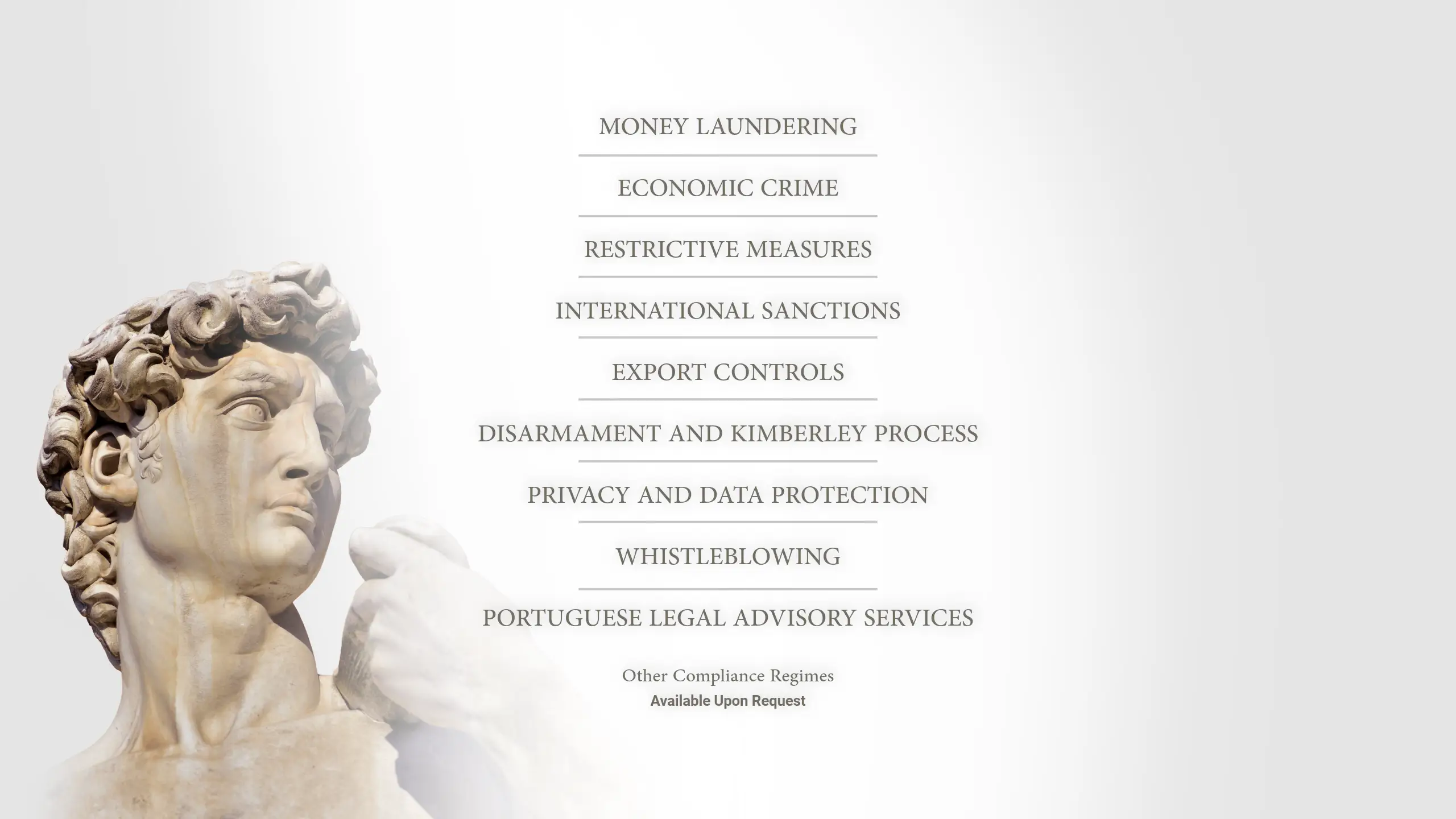
Carlos Ramires Compliance Law Advisory Services
- Anti-Money Laundering (AML)
- Economic Crime
- Restrictive Measures
- Export Controls
- Disarmament
- Kimberley Process
- Privacy and Data Protection
- Whistleblowing
- Other Compliance Regimes Available Upon Request


Covered Jurisdictions
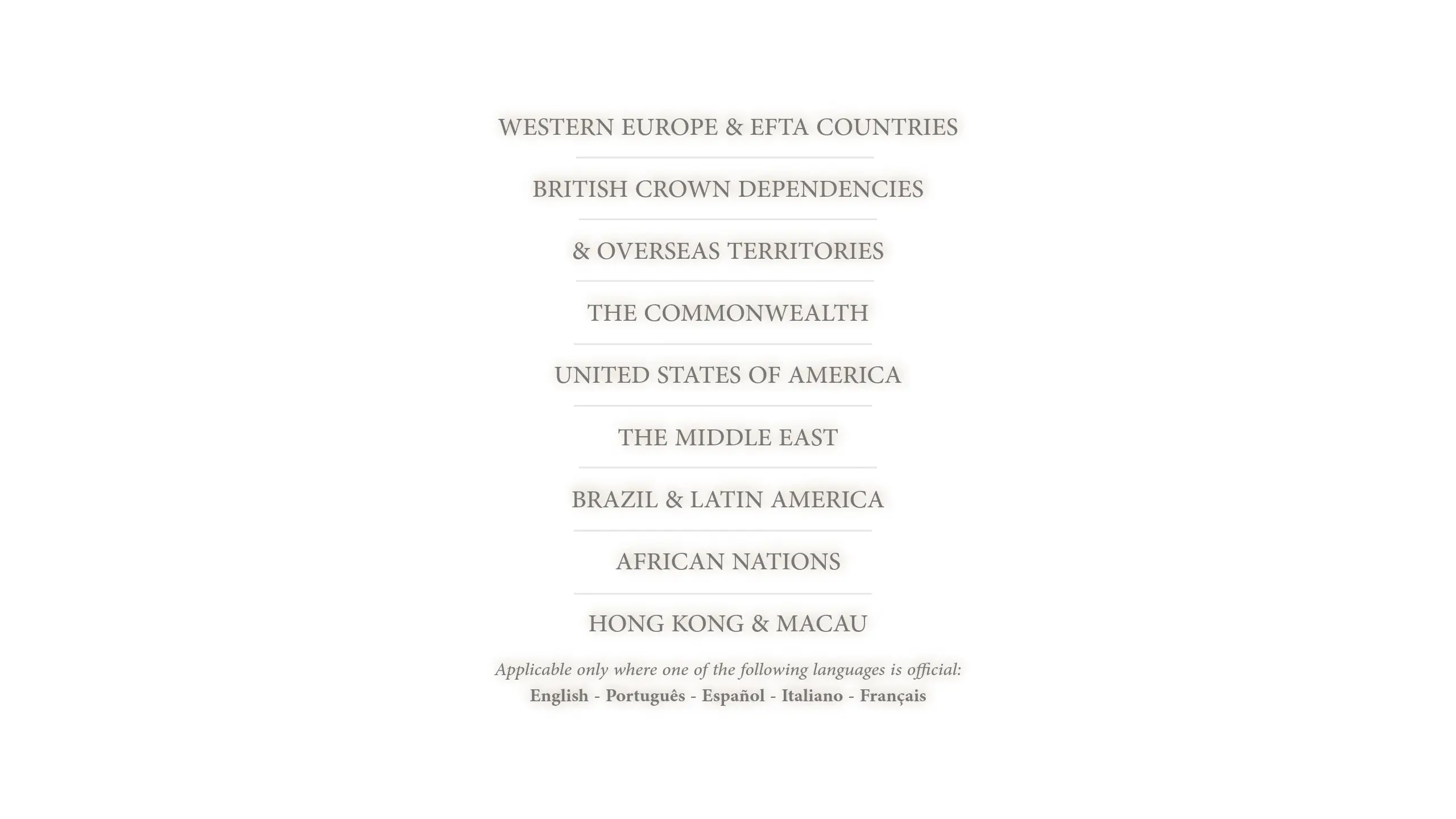
Applicable Jurisdictions
- Western Europe and EFTA Countries
- British Crown Dependencies and Overseas Territories
- The Commonwealth
- United States of America
- The Middle East
- Brazil and Latin America
- African Nations
- Hong Kong and Macau
- Applicable only where one of the following languages is an official language:
- English • Português • Español • Italiano • Français


Governance and Ethics
Governance and Ethics
- International Legal Advisory Services
- Non-reserved Legal Activities
- Confidentiality
- Independence and Impartiality
- Conflict of Interest Disclosures
- Qualified Professional Privilege
- Bespoke Privacy Agreement
- Freedom of Enquiry
- Right of Withdrawal
- Official Languages

Background and Domestic Legal Services
Background and Domestic Legal Services
- Portuguese Legal Advisory Services
- Estate, Family and Inheritance Law
- Property and Real Estate
- Contracts and Public Deeds
- Governance and Corporate Law
- Compliance and Private Auditing
- Investment, Residence and Visas
- Portuguese Tax and Public Administration
- European Union Law
- Civil and Business Representation



Contact Information Poster
Poster titled "Private Contact Channels".
The poster explains that certain contact details have been deliberately anonymised to protect against impersonation, data scraping, and to preserve client confidentiality.
An information icon displayed on the left side of the poster provides additional details regarding these privacy measures.
- Telephone: Confidential
- Email for general enquiries: info@carlosramires.eu
- Private ERDS: www.carlosramires.eu
- Proton, Signal, Microsoft Teams: Confidential
- LinkedIn profile: carlosramires-compliancelaw
Browsing Transparency
1. Kindly note that browsing www.carlosramires.eu will not trigger or result in the installation of any files, cookies, or tracking technologies on the visiting browser, much less collect, profile, or report any automatically transmitted data, such as IP addresses or technical protocols. Standard web server access and security logs may, nonetheless, operate within the hosting infrastructure where the website is deployed, or within the visiting browser itself, yet entirely outside the scope, awareness, and control of this website.
2. At the visitor’s request, consent for the installation of a local storage unit shall only be required for the sole purposes of operating the website’s ERDS privacy vault or defining its accessibility settings, but always without performing any data collection, storage, or analysis actions. Its removal or deletion will be available at all times via a dedicated “reset button”, and the status regarding all such operations shall automatically be provided to the operating visitor without any human intervention.
3. The browsing of www.carlosramires.eu shall likewise never become subject to, or ever give cause to presume or imply, any form of data-processing consent, pre-contractual agreement, or the waiver of rights; nor shall it, for such purposes, resort to or make use of standard contractual clauses, bundled terms, or pre-ticked consent mechanisms, save for the permission as above-mentioned.
Binding Contractual Effects & Confidentiality
4. As all legal commitments and privacy agreements shall solely arise from the act of a tailored and individually negotiated contract — and following only the expiry of a free withdrawal period as to be specified — no enquiries, preliminaries, conditions, or offers under consideration shall give rise to any legally binding or contractual obligations until formally executed in writing as aforesaid.
5. All communications shared with Carlos Ramires Compliance Law shall be held strictly confidential and subject to GDPR standards and qualified professional privilege protections, irrespective of their personal or non-personal nature, albeit without prejudice to statutory disclosure requirements that may apply, such as those arising from anti-money laundering and economic crime regulations.
6. English and Portuguese shall be the sole official languages available for service, commitments, and documentation. Enquiries in any other language will be greatly welcomed and replies shall be provided purely as an act of courtesy, yet subject to the explicit understanding and agreement that AI translation models may be used without human revision, as set forth and further explained in the AI Use Statement of Principle above. Save as required by applicable statutory obligations, no data shall be processed without explicit, individual, and tailored consent.
AI Use Statement of Principle
7. All content available on www.carlosramires.eu, as well as all documents, services, and communications to be issued or delivered, shall be subject to Artificial Intelligence review for the sole purposes of applicable professional editing and ensuring, where possible, a standard of international English free of any potential local colloquialisms, in alignment with established Plain English Campaign and UK Government Digital Service (GDS) standards.
8. To mitigate privacy, cybersecurity, and environmental concerns, all AI operations at Carlos Ramires Compliance Law shall be strictly restricted to Small Language Models (SLMs) and privacy-first infrastructures, such as Swiss-based Proton and Infomaniak. No personal data or any other details shall ever be subject to AI processing without explicit consent, as aforesaid, and no operational exchanges shall be delegated to automated reply systems, other than those technically provided for under Paragraph 2 hereof.
9. www.carlosramires.eu and, by default, all information it might receive shall be securely hosted on Infomaniak’s Swiss infrastructure with TLS/HTTPS encryption in transit. For end-to-end encryption (E2EE), users or clients shall be inquired as to their preference to use Proton, Signal, or pseudonymisation features.
Open Access and Moral Rights
10. In view of standard or prevailing screening requirements, all content displayed on www.carlosramires.eu is hereby made available for the public’s free, legitimate, and personal benefit, in whatever form such benefit may arise, provided, however, that no such use is made that could misrepresent the author’s statements, opinions, or views, or expose him to any liability or reputational harm.
11. The permissions of use granted under Paragraph 10 above shall strictly exclude commercial publishing, as well as any logos, photographs, and other graphic or design assets.
12. Reproduction, adaptation, or redistribution is formally authorised without the need for any citation, attribution, or permission — and free of all copyright or licensing restrictions that would traditionally apply — although without entailing or implying the waiver, loss, limitation, or transfer of any moral rights — namely the right to authorship, the right to modify, delete, or withdraw content from public availability, and the right to the integrity of the work — which shall remain reserved as provided for in Article 56 of the Portuguese Copyright and Related Rights Code (Código do Direito de Autor e dos Direitos Conexos) and under the principles governing freedom of will established by the Berne Convention (1886), the TRIPS Agreement (1994), and the WIPO Copyright Treaty (1996).
13. Notwithstanding, the exercise of any such reserved moral rights shall operate solely for the future without affecting or invalidating the continued use, reproduction, or reliance by third parties upon any copies previously downloaded, shared, or lawfully acquired in good faith.
Legal effects
14. For the avoidance of any doubt, the permissions and concessions of use set forth herein are hereby issued under the doctrinal and statutory framework governing public declarations within Romanic legal systems, and the doctrines of promissory estoppel within Common Law jurisdictions — including, inter alia, Article 225 of the Portuguese Civil Code and the principles affirmed in Central London Property Trust Ltd v. High Trees House Ltd [1947] (UK) — with the express intention of conferring upon all beneficiaries the highest attainable degree of legal assurance regarding such use and of pre-emptively neutralising any potential claims, objections, or liabilities that may arise in connection with potential doubts or infringements of intellectual property rights.
15. Kindly note, however, that as the contents of www.carlosramires.eu are meant for illustrative and informational purposes only, they have not been structured to act as any form of legal advice and will not reflect any legal amendments that might be enacted after their date of publication.
16. Accordingly, they must not be taken or relied upon, under any circumstances, for any specific legal effects until validated by professional legal counsel.
Accessibility & Plagiarism Cautions
17. Please be advised that, in compliance with digital accessibility requirements and for the purposes of supporting digital Braille and other neurodiversity-assisting technologies, all content available on www.carlosramires.eu will also be published in open HTML format.
18. It will be, consequently, readily indexed and detectable online by automated anti-plagiarism and content-detection systems (such as Turnitin, iThenticate, Ouriginal, or GPTZero), which, in certain circumstances, may trigger automated false-positive plagiarism flags and subject users to unintended academic scrutiny or reputational friction.
19. While any such unintended inconveniences are deeply regret-ted and apologized for in advance, users are kindly advised to manage these risks in accordance with standard academic and professional practices in order to address and prevent any potential adverse impact.
20. Alternatively, the source may also be explicitly disclosed or cited ("www.carlosramires.eu") to clarify and immediately dismiss any such unfortunate misunderstandings.
Spoofing, OSINT and Impersonation
21. Kindly note that all personal, sensitive, or GDPR-relevant data traditionally expected to be disclosed on the website has been intentionally removed for the purposes of safeguarding the confidentiality of our clients’ assignments — particularly when involving highly sensitive matters or potential litigation — and to adhere to “surface minimisation” principles as recommended by recognised cybersecurity authorities such as CERT-EU (Cybersecurity Mitigation Measures Against Critical Threats), the ENISA Threat Landscape, the UK Government Cyber Security Policy Handbook, and NCSC Guidance.
22. Accordingly, all contact details are to be disclosed at a later stage following the applicable mutual trust protocols. A public email address for general enquiries is made available, alongside an official LinkedIn profile which must not be used, under any circumstances, for the transmission or sharing of any personal, sensitive, or private information. Until the completion of the mutual trust protocols, visitors are encouraged to communicate anonymously or under a pseudonym of their choice. Please refer to our Mutual Trust Protocols for further details.
23. All forms of data-crossing, profiling, and Open-Source Intelligence (OSINT) — whether automated or manual — as well as any background checks, are hereby strictly prohibited unless and until specifically authorized. Likewise, all forms of spoofing, data mining, and the harvesting or scraping of content for the training of artificial intelligence or machine learning models are equally prohibited.
24. Whenever necessary, all relevant personal or institutional details required for specified legitimate purposes will be provided exclusively within an appropriate, controlled, and purpose-bound environment, subject to explicit and individual agreement.
25. All mandatory legal-compliance screening or vetting requirements that may be applicable — such as those provided under the AML/CFT Regulations — shall only be accepted or undertaken where a specific and informed preliminary purpose has been clearly established or following a formal decision to proceed with a contractual engagement.
Consent & Data Protection Safeguards
26. Limited and conditional consent is hereby granted for the retention and processing of the public personal data made available on this website, yet for the purposes of reference or initial consideration only.
27. Kindly note that the consent hereby provided will not exempt, absolve, or release any party from their overarching legal obligations to handle, process, and maintain these details in strict compliance with all applicable privacy and data-protection laws.
28. Accordingly, any potential consent rendered through the use of third-party proprietary communication platforms or vendor portals shall not, under any circumstances, imply or constitute any broader consent insofar as the use and processing of our data is concerned.
GDPR, CJEU and UK Judiciary
29. In accordance with GDPR Regulations and the principles affirmed by the UK Judiciary in RTM v. Sky Betting and Gaming [2025] EWHC 111 (KB) and by the Court of Justice of the European Union (CJEU) in Orange România SA v. ANSPDCP (Case C-61/19), it must be formally accepted and understood that:
a) The sharing, transmission, or processing of all personal details provided hereof for any purpose beyond initial consideration is strictly prohibited, unless expressly authorised under a personal or authenticated electronic signature;
b) No automated, implied, or “one-size-fits-all” forms of consent that might be claimed to exist — particularly when arising from generic “privacy policy” consents, website visits, software-installation protocols, cookies, or other online mechanisms — shall be accepted, recognised, or deemed lawful under any circumstances; and
c) Where, for the avoidance of doubt, any such consent may be claimed to exist, it is hereby formally and expressly withdrawn.
30. Should you or your team be inadvertently unable to comply with these terms, we would be grateful if you could inform us promptly so that appropriate redress measures may be discussed and adopted in good faith.
We sincerely appreciate your cooperation and understanding. Thank you and "obrigado" for your thoughtfulness.